Basic Research in Nuclear Physics and Nuclear Astrophysics
Operation, Maintenance and Development of Heavy Ion Accelerators
Development of Instrumentation for Nuclear Physics Research
Reactor Based Neutrino Physics Research
Nuclear Data and Accelerator Based Applied Research
Theoretical Nuclear Physics and Quantum Computing
A unique facility in the country for prompt
\r\ngamma coincidence spectroscopy using
\r\nthermal neutron beam
Experimental values of nuclear level density parameter are known only sporadically at
\r\nexcitation energies that corresponds to nuclear temperature T = 1 to 4 MeV. Its isospin
\r\ndependence is even lesser known. We are pursuing a program to measure this quantity in
\r\nnuclei of size typical of fission fragments and the results will be useful for basic
\r\nunderstanding as well as new nuclear technology applications. Experimental tool is
\r\nevaporative alpha-particle spectra measurement in fusion reactions and a statistical model
\r\nanalysis thereof. Recent results from two reactions are given below.
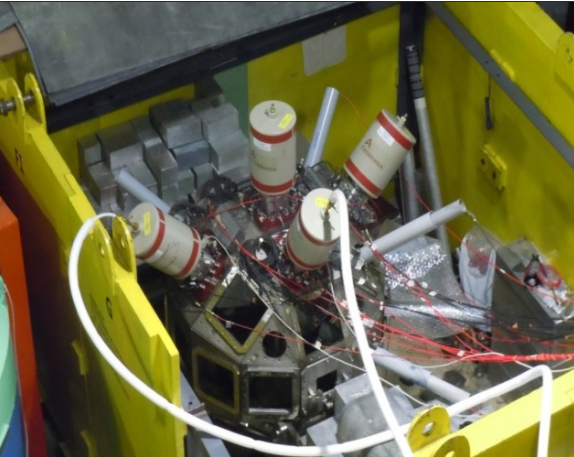
The Indian Scintillator Matrix for Reactor Anti-Neutrinos – ISMRAN, is an experiment designed for reactor antineutrino measurements for realizing the goals of reactor monitoring and studies on active-sterile neutrino mixing to understand the Reactor Antineutrino Anamoly (RAA). ISMRAN Phase – I (1 ton by weight in an interactive volume of 1 m^3 , of Gd wrapped Plastic Scintillators,
\r\nwith 200 channels of read outs via digitizers) has been currently assembled at Hall-9, BARC
Neutrino oscillations represent a phenomenon in which quantum mechanical effects are observed at long distance scales. This provides us the opportunity to study the quantum mechanical features of this system such as geometric phase and quantum coherence in a unique manner. In particular, the appearance of geometric phases in neutrino oscillations have been pointed out in several previous studies. However, all of them consider the case of pure neutrino states, which cannot be realized in a typical scenario.
\r\n
\r\nIn this work, we consider the more general case of an incoherent beam of neutrinos, and derive the expressions for geometric phase in both two flavor and three flavor models. We discussed the geometry of the state space of neutrino oscillations and its connection with the appearance of a geometric phase. For two flavor oscillations, the geometric phase is shown to be independent of the Majorana phase, however for three flavor oscillations the geometric phase shows non-trivial dependence on the Dirac CP-violating phase. We also show that our results generalize the previously obtained expressions of the pure state geometric phase for neutrino oscillations in vacuum and in non-dissipative matter. In addition, the comparison between geometric phase and information-theoretic quantum coherence is also highlighted.
\r\n
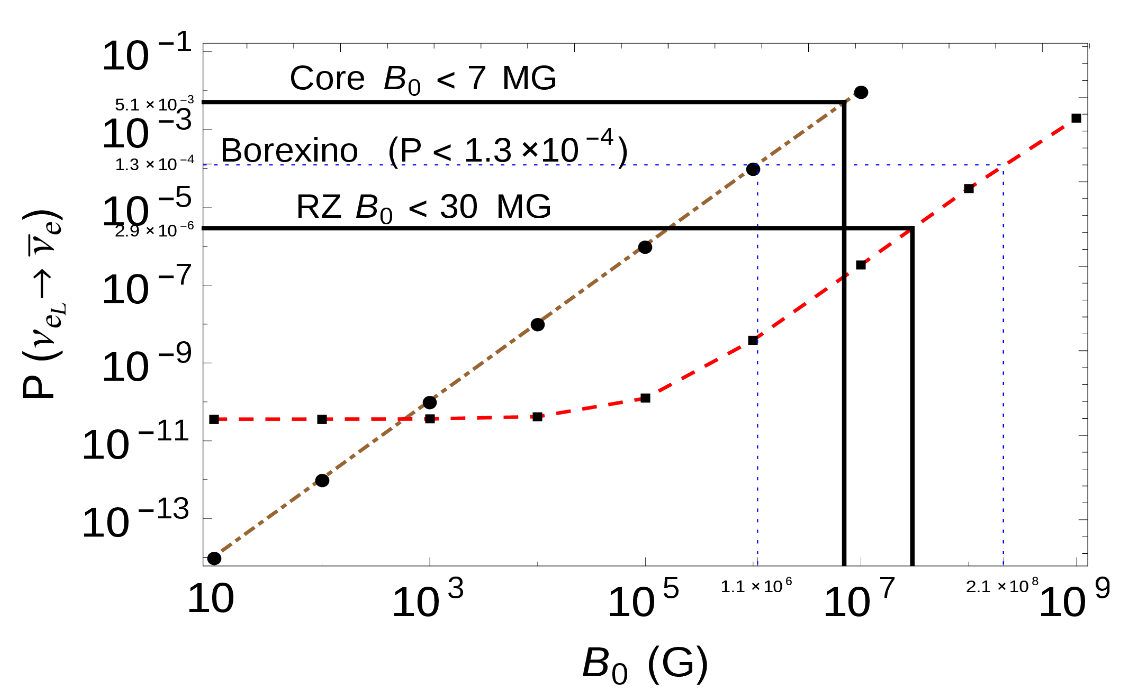
we have studied the phenomenon of neutrino spin-flavor oscillations in the Sun for neutrinos having sufficiently large magnetic moments ~ 10 ^-11 μ B. We have constructed two models for solar magnetic field based on the current bounds on the magnetic field in different regions of the Sun. In the first model, one can have large magnetic field in the solar core and it tapers off with distance from the center. In the second model, we have a large magnetic field in the RZ which becomes negligible in the core region and in addition there is a CZ magnetic field. We have also obtained a novel parametrization for the electron density profile in the Sun, which provides a better approximation compared to the usual exponential parametrization.
Measurements of prompt fission neutrons and gamma rays spectra have been carried out in the fast neutron induced fission of 232Th at an average neutron energy of 2.6 MeV at FOTIA, BARC. The Maxwellian temperature obtained from the prompt fission neutron
\r\nspectrum is found to be 1.22 ± 0.03 MeV. An estimate of the average gamma energy could be obtained as 0.91 ± 0.04 MeV.
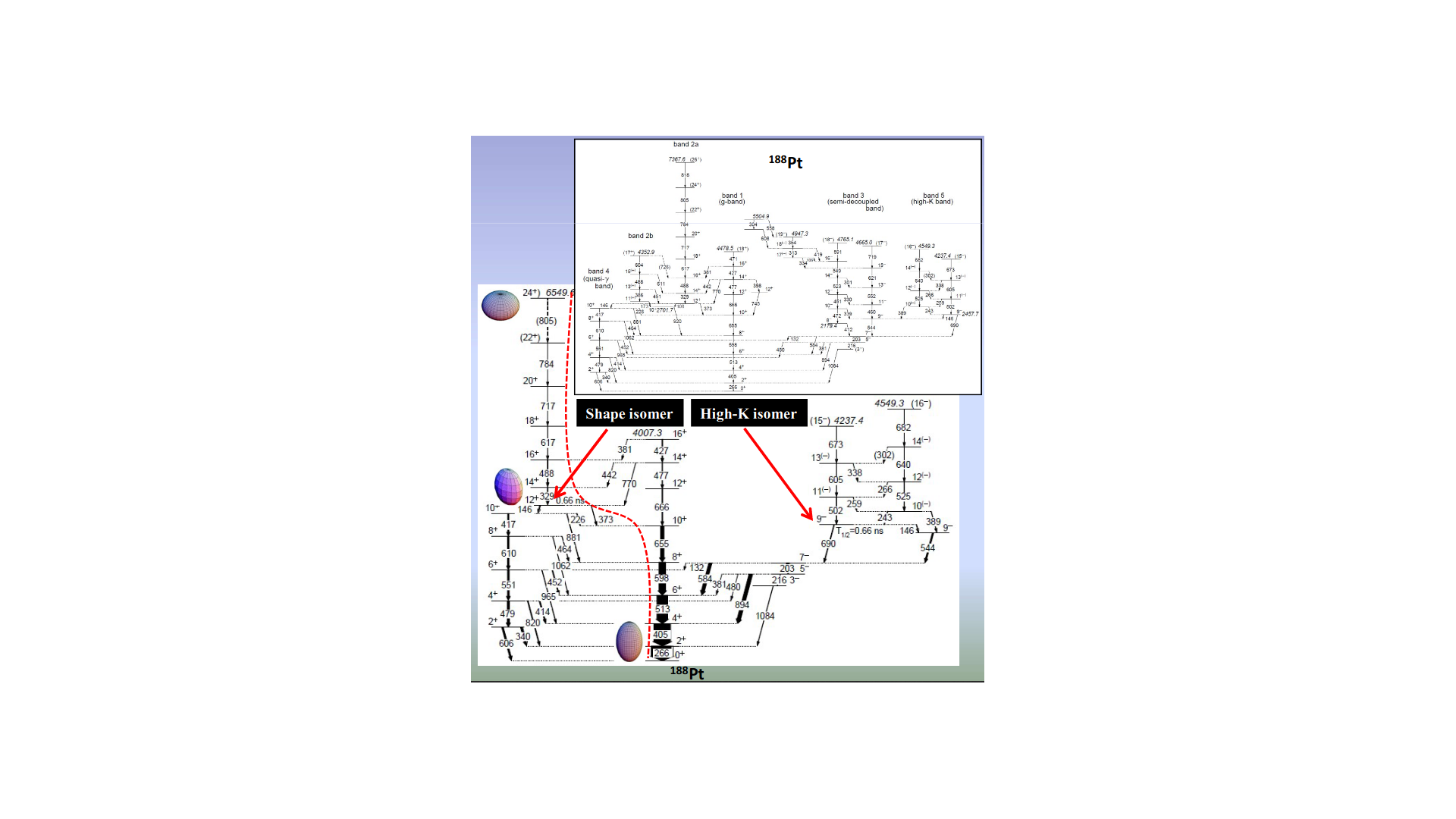
Exploration of nuclear structure in nuclei of A ~50 and A ~ 180-190 using INGA
We have presented relativistic analogue of the celebrated Anderson localization
\r\nin one dimension. We use Dirac equation to calculate the transmission
\r\nprobability for a spin-1/2 particles incident on a disordered chain of rectangular
\r\nbarriers. Using the transfer matrix formalism, we compute the transmission
\r\nprobability for the case of a large number of identical barriers spread randomly
\r\nin one dimension. The particular case when the incident particle has three-
\r\ncomponent momentum exhibiting spin-flip phenomenon is also considered. The
\r\nremarkable result ensuing from this study is that ours is a systematic
\r\ngeneralization of the famous work by Anderson in 1958 – those results are
\r\nrecovered in a non-relativistic limit.
This highlight represents the outcome of one of the thesis works which addresses crucial aspects of nuclear collectivity on an absolute scale along the stable Sn isotopic chain within single experiments.
Measurement of reaction cross-sections critical to
\r\nFusion reactors
Low energy carbon ion induced M X-ray relative intensities
\r\nfor 70Yb, 82Pb and 83Bi
Anomalous oscillatory features in neutron emission from
\r\nD + D fusion in palladium at 100 keV implantation energy
Modeling of tagged neutron method for explosive
\r\ndetection using GEANT4
This highlights results of one of the completed thesis work which deals with the understanding of breakup
\r\nreactions of weakly bound stable projectiles <sup>6,7</sup> Li by medium mass nuclei <sup>112</sup> Sn
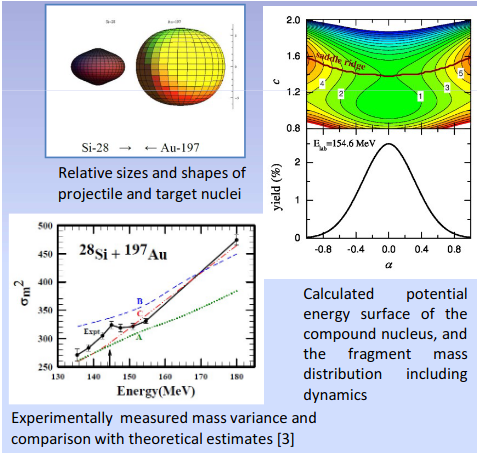
Understanding the nuclear scission process from alpha particle accompanied HI fission
For the synthesis of super heavy elements, it is proposed to fuse neutron rich radioactive ion beam (RIB) with heavy targets. It is now well known that the reaction mechanisms using RIB having small particle separation energy can be simulated by using weakly bound stable projectiles having low breakup threshold. In case of weakly bound stable projectiles, the study of fission rocess following compound nucleus formation becomes complicated as it gets mixed up with various breakup or transfer induced fission channels.
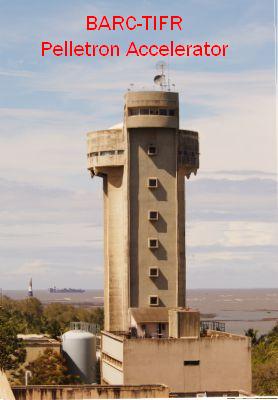
The Pelletron-Linac facility, set up as a joint project between NPD-BARC and the Tata Institute of Fundamental Research, has been a major centre for the heavy ion accelerator based research and applications in India. NPD (Nuclear Physics Division) operates, maintains and upgrades the BARC-TIFR Pelletron Accelerator. The Pelletron accelerator has been delivering wide variety of ion beams round-the-clock ever since it’s commissioning in December 30, 1988.
This technique is established in March 05, 2016 and is being extensively used for various measurements, successfully.
The high current irradiation set up at 6 meter level was developed and utilized for radioisotope production since September 18, 2004 and subsequently customized
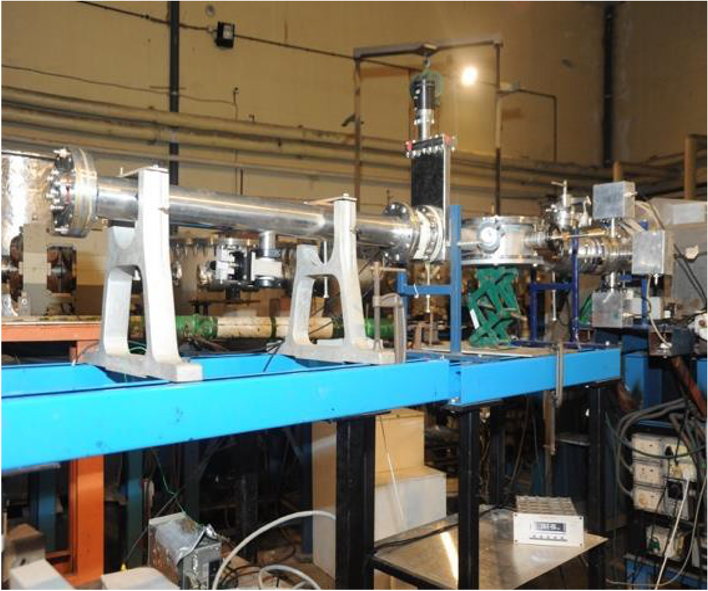
\r\nto perform secondary neutron production in June 01, 2013 and more recently for radiopharmaceutical and ther applications. Several applications require the neutron yield to be as high as 107-109 n/s. This facility also provides neutron yield in the range of 107-108 n/s via protons bombarding Lithium or Beryllium targets with few MeV and few hundreds of nA beam current. Allows irradiation of solid as well as liquid samples. This facility is also being used for radio pharmaceutical and tracer applications.
Low flux of protons in the range of 103 to 108 particles/cm2/s in air is required for radiological applications and qualification of space based electronic devices. This set up has been utilized since November 01, 2007 and undergone various up-gradations. The set up is further customized in January 9, 2018 for conducting induced-mutation studies in grains, successfully. Induced-mutation in Rice and Wheat using low flux proton beam is being pursued by NA&BTD, BARC. The set up is tailored as per experimental requirements. The testing of space bound electronic devices is extensively performed by ISRO. This set up is continuously modified as per their typical requirements.
The setup for the large scale production of TEMs consists of a magnetic beam scanner, horn chamber and a rolling mechanism. This set up is being used since November 01, 2007 and continuously customized as per user requirements. Pore density and pore size; 106 -108 pores/cm2 and 0.8-1.6
\r\nmicrons. These membranes have been utilized for various applications.
\r\n
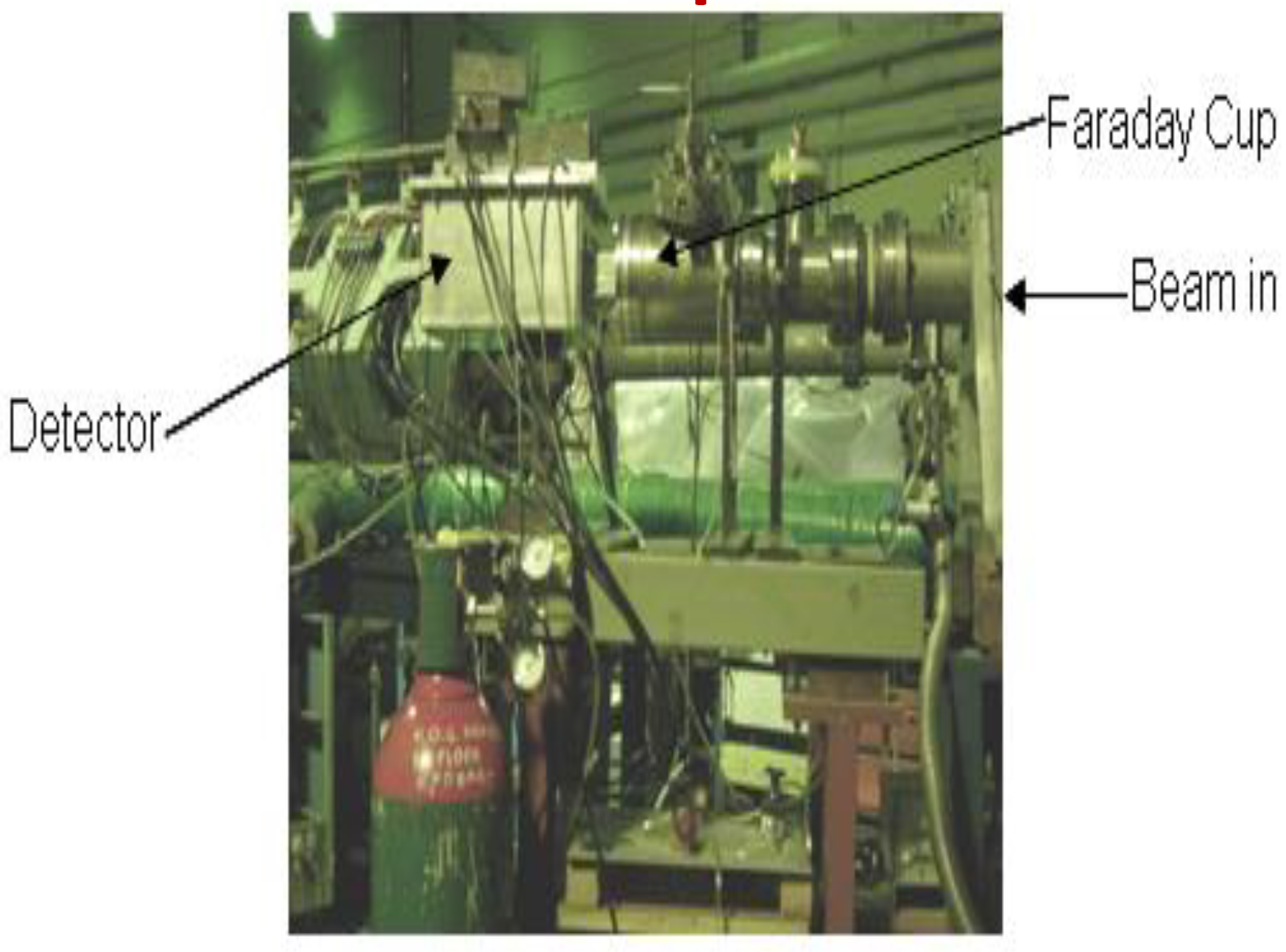
An ultra-sensitive means of counting individual
\r\n atoms of long half life. This technique was established for 36Cl in
\r\n Jan 05, 2009 and improvised subsequently. The measurements further extended to 129I detection and ‘exotic’ polyatomic anions identification.
A compact array of seven hexagonal BaF2 detectors with cosmic ray background suppression
\r\nhas been setup for the measurement of high energy photon up to ~30MeV. Each BaF2 detector is
\r\nhaving a length of 20 cm and a hexagonal cross-section with a face-to-face distance of 6 cm. The
\r\nscintillator is viewed by a 50 mm diameter fast PMT with quartz window. The array is
\r\nsurrounded by an annular plastic cylinder of thickness 5 cm and length 40 cm which is used to
\r\nreject the cosmic ray background. The array has been used to measure the GDR photons in low
\r\nenergy heavy-ion reactions.
An array of 18 liquid scintillators (LS) is set-up for fast neutron spectroscopy. Each liquid
\r\nscintillator is a 5-inch diameter and 2-inch long cylindrical Aluminum Cell coupled to a 5-inch
\r\ndiameter fast PMT. These detectors have very good timing and also pulse shape discrimination
\r\n(PSD) properties. Therefore, exploiting the time of flight techniques and PSD, it is possible to
\r\nhave unambiguous detection of neutrons among the gamma-ray background. The array has been
\r\ncharacterized for measurements of both electrons using radioactive sources and fast neutrons
\r\nusing (p,n) reaction.
A large area neutron detector array (~1m × 1m ) has been set up and consists of 16 plastic
\r\nscintillator bars of square cross section (see figure). Each bar has a size of 6 cm × 6 cm × 100 cm
\r\nand is coupled to two 5 cm diameter XP2020 PMTs, one at either end.
An annular PPAC has been developed to handle the high count rate at forward angles while
\r\nseparating the quasi elastic (QE) events and the fusion residue (FR) events by time of flight
\r\nmeasurements. A transparent mylar window is supported by a stainless steel frame and a thin
\r\naluminized mylar cathode with its supporting frame. The anode consisting of a double sided PCB
\r\nis segmented into 12 parts comprising 4 sectors and 3 rings with varying widths which provides
\r\n(θ, Φ) information of FRs. The PPAC is integrated with a thin wall chamber in the 45 deg. beam
\r\nline in Hall-1 of the PLF along with a 38-element BGO multiplicity setup. A typical TOF
\r\nspectrum obtained by one of the segments of PPAC in coincidence with the BGO array, as
\r\nshown in figure below, demonstrates a clear separation of FR from QE events. The FR tagging
\r\nefficiency of the PPAC has been found to be ~25% in the 124Sn+ 28Si reaction at188 MeV
INGA is a well known device for nuclear structure studies that is being used in various heavy ion accelerator facilities in the country on a rotation basis. It consist of more than twenty Compton-suppressed Clover HPGe detectors and other ancillary detectors. INGA has a national committee (PICC) with members from TIFR, BARC, VECC, SINP, IUAC, UGC-DAE-CSR-KC, Universities, and IITs for project implementation, coordination, and up-gradation of the facility. While INGA is located in Pelletron Linac Facility, TIFR, NPD contribute about 20% of the required resources in terms of equipments and manpower.
This array, located in Pelletron Linac Facility, consists of several tens of Si-CsI detector modules and other ancillary-detectors for investigations in nuclear structure at elevated temperatures and angular momenta, exotic nuclear clusters, charged particle accompanied fission and related fields. Recent results on the variation of nuclear level density with excitation and isospin in nuclei were obtained using the array.
Hydrogen gas cell setup for forward-focused fast neutron
\r\nsource at 25o HS beam-line at FOTIA
Experimental setup for the study of neutron emission
\r\nfrom D-D fusion in metal lattices at ECR, NPD, BARC
Experimental setup for the study of fast neutron induced
\r\nfission of actinides at FOTIA facility, BARC
1.5 meter diameter fully automated chamber at Hall1, 30 degree
\r\n
\r\nIn-vacuum computer controlled 360 degree rotation of 2 detector
\r\narms along with target height and orientation adjustment
\r\n
\r\nIn-vacuum target transfer
\r\n
\r\nMulti-pin vacuum feed-throughs for signals
\r\n
\r\nGas feed-throughs along with PLC based gas flow controller