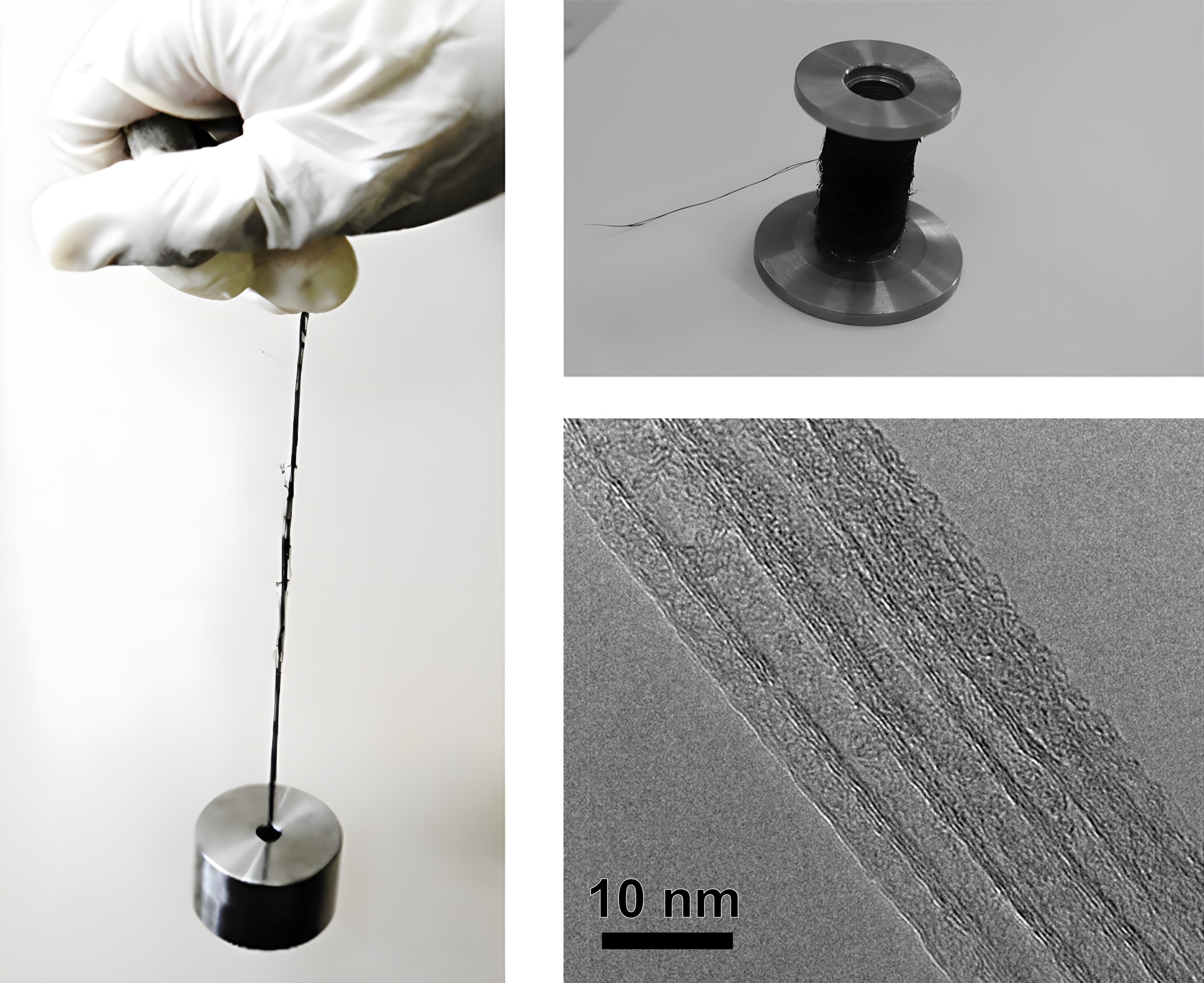
Carbon nanotubes (CNTs) possess extraordinary strength, high electrical and thermal conductivity, and exceptional flexibility. The Floating Catalyst CVD (FC-CVD) process is designed to translate these nanoscale advantages into continuous, macroscopic CNT fibers suitable for advanced industrial applications.
In FC-CVD, CNTs grow in the gas phase from catalyst nanoparticles and spontaneously assemble into a continuous fiber as they form. This unique one-step, uninterrupted process enables true industrial scalability, producing long, uniform CNT fibers that can be directly wound, woven, or integrated into composite systems. Its continuous nature ensures consistent quality and high production rates, supporting smooth and reliable technology transfer.
FC-CVD CNT fibers retain the remarkable attributes of individual nanotubes, including lightweight strength, high conductivity, thermal stability, and mechanical durability. These properties make them ideal for aerospace structures, smart and wearable electronics, EMI shielding, lightweight power cables, flexible sensors, and multifunctional composite reinforcement.
With unmatched continuity, scalability, and performance rooted in CNT science, FC-CVD technology offers a powerful platform for industries adopting next-generation advanced materials.
Perquisite: A company with experience in producing CNT powder by CVD method can apply.
INTRODUCTION
Carbon nanotubes (CNTs) are among the most advanced materials available today, combining exceptional tensile strength, high electrical and thermal conductivity, low density, and remarkable chemical stability. Translating these nanoscale properties into useful macroscopic forms has long been a technological challenge. Floating Catalyst Chemical Vapor Deposition (FC-CVD) overcomes this limitation by enabling CNTs to grow and assemble simultaneously into a continuous fiber. This technology bridges the gap between laboratory-scale CNT synthesis and industrial-scale production, making high-performance CNT fibers accessible for aerospace, electronics, energy systems, and next-generation composite materials. FC-CVD stands out for its simplicity, robustness, and scalability, providing a reliable route to produce long, uniform CNT fibers suitable for direct use in industrial production.
APPLICATION
CNT fibers produced via FC-CVD enable a broad spectrum of advanced applications. Their high conductivity and low weight make them suitable for next-generation power cables, flexible conductors, and electromagnetic interference (EMI) shielding materials. Their strength and flexibility support aerospace components, lightweight structures, and multifunctional composite systems. CNT fibers are ideal for wearable electronics, soft robotics, flexible sensors, and structural health-monitoring systems. They also offer advantages in energy devices, such as supercapacitor electrodes, battery current collectors, and thermal management systems. The combination of performance, flexibility, and scalability positions CNT fibers as a transformative material across multiple industries.
SPECIFICATION
| Sr. No. | Specification | Value |
|---|---|---|
| 1 | Production rate | 0.5 Km/h |
| 2 | CNT Type | Multi walled |
| 3 | CNT Diameter | 5-25 nm |
| 4 | Purity | > 90% |
Carbon nanotubes (CNTs) are among the most advanced materials available today, combining exceptional tensile strength, high electrical and thermal conductivity, low density, and remarkable chemical stability. Translating these nanoscale properties into useful macroscopic forms has long been a technological challenge. Floating Catalyst Chemical Vapor Deposition (FC-CVD) overcomes this limitation by enabling CNTs to grow and assemble simultaneously into a continuous fiber. This technology bridges the gap between laboratory-scale CNT synthesis and industrial-scale production, making high-performance CNT fibers accessible for aerospace, electronics, energy systems, and next-generation composite materials. FC-CVD stands out for its simplicity, robustness, and scalability, providing a reliable route to produce long, uniform CNT fibers suitable for direct use in industrial production.
In the FC-CVD method, catalyst precursors and carbon precursors are injected into a controlled high-temperature zone where CNTs nucleate and grow directly within the gas phase. As the CNTs are generated, they naturally entangle and align due to flow dynamics, forming a continuous aerogel-like CNT sock. This sock is drawn out of the reactor and densified mechanically to form a continuous CNT fiber. The entire sequence occurs in a single uninterrupted step, ensuring consistent fiber morphology and minimal contamination. The fiber can be collected onto spools, woven, braided, or immediately fed into composite processing systems. The process does not require vacuum systems, batch steps, or complicated catalyst preparation, making it ideal for continuous production environments. Its modular design also allows straightforward scaling by increasing reactor length or precursor injection capacity.
CNT fibers produced via FC-CVD enable a broad spectrum of advanced applications. Their high conductivity and low weight make them suitable for next-generation power cables, flexible conductors, and electromagnetic interference (EMI) shielding materials. Their strength and flexibility support aerospace components, lightweight structures, and multifunctional composite systems. CNT fibers are ideal for wearable electronics, soft robotics, flexible sensors, and structural health-monitoring systems. They also offer advantages in energy devices, such as supercapacitor electrodes, battery current collectors, and thermal management systems. The combination of performance, flexibility, and scalability positions CNT fibers as a transformative material across multiple industries.
ADVANTAGE
FC-CVD delivers unmatched benefits for industrial CNT fiber production. The process is continuous, enabling long-length fiber manufacturing at high throughput. It is inherently scalable, ensuring easy transition to large reactors or multi-line systems. CNT fibers produced through FC-CVD maintain lightweight strength, high conductivity, and exceptional flexibility, enabling applications in aerospace, EMI shielding, wearable electronics, sensors, and advanced composites. Open-air operation simplifies the setup and improves safety while reducing costs. Together, these advantages position FC-CVD as a robust and future-ready platform for commercial CNT fiber manufacturing.