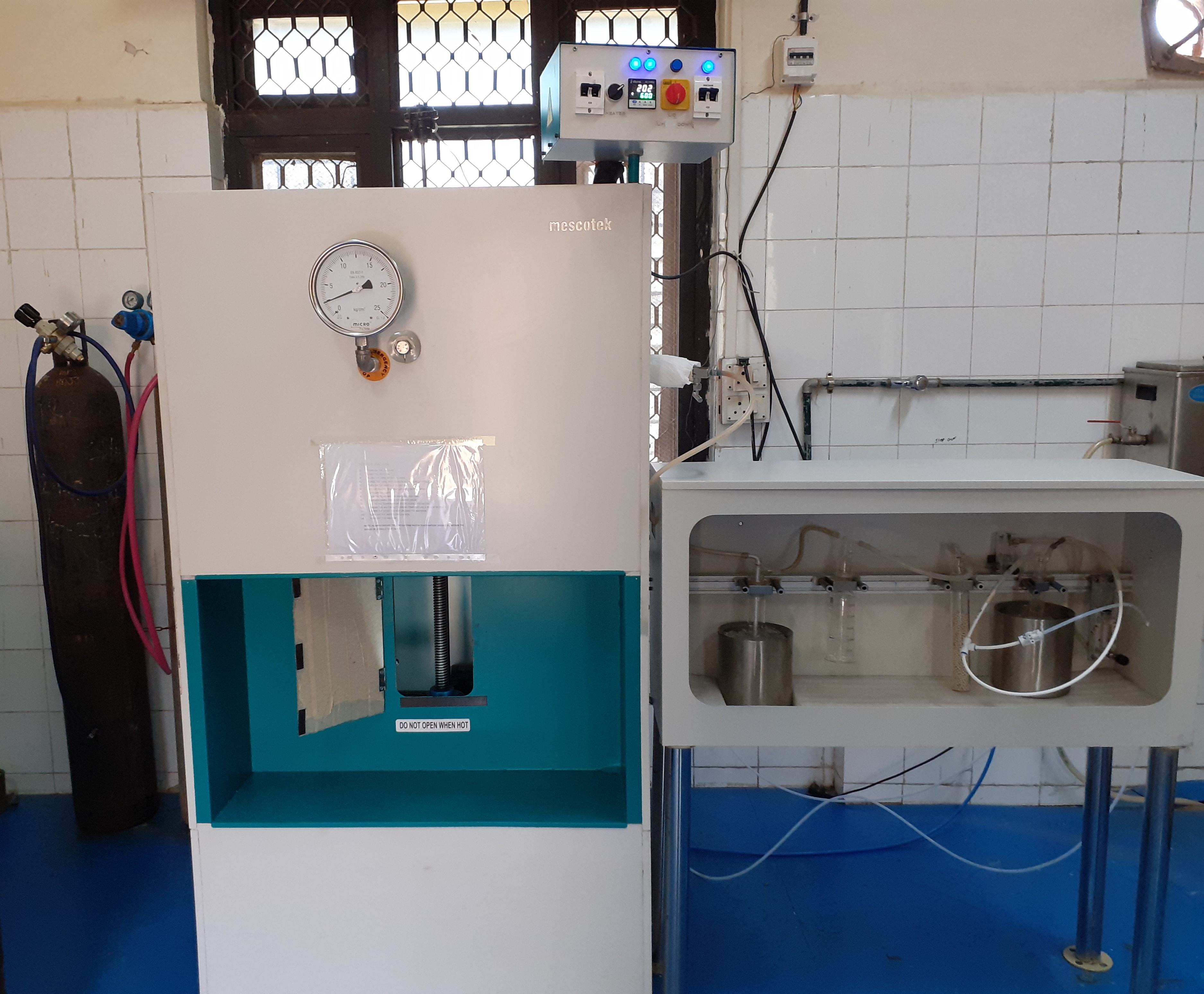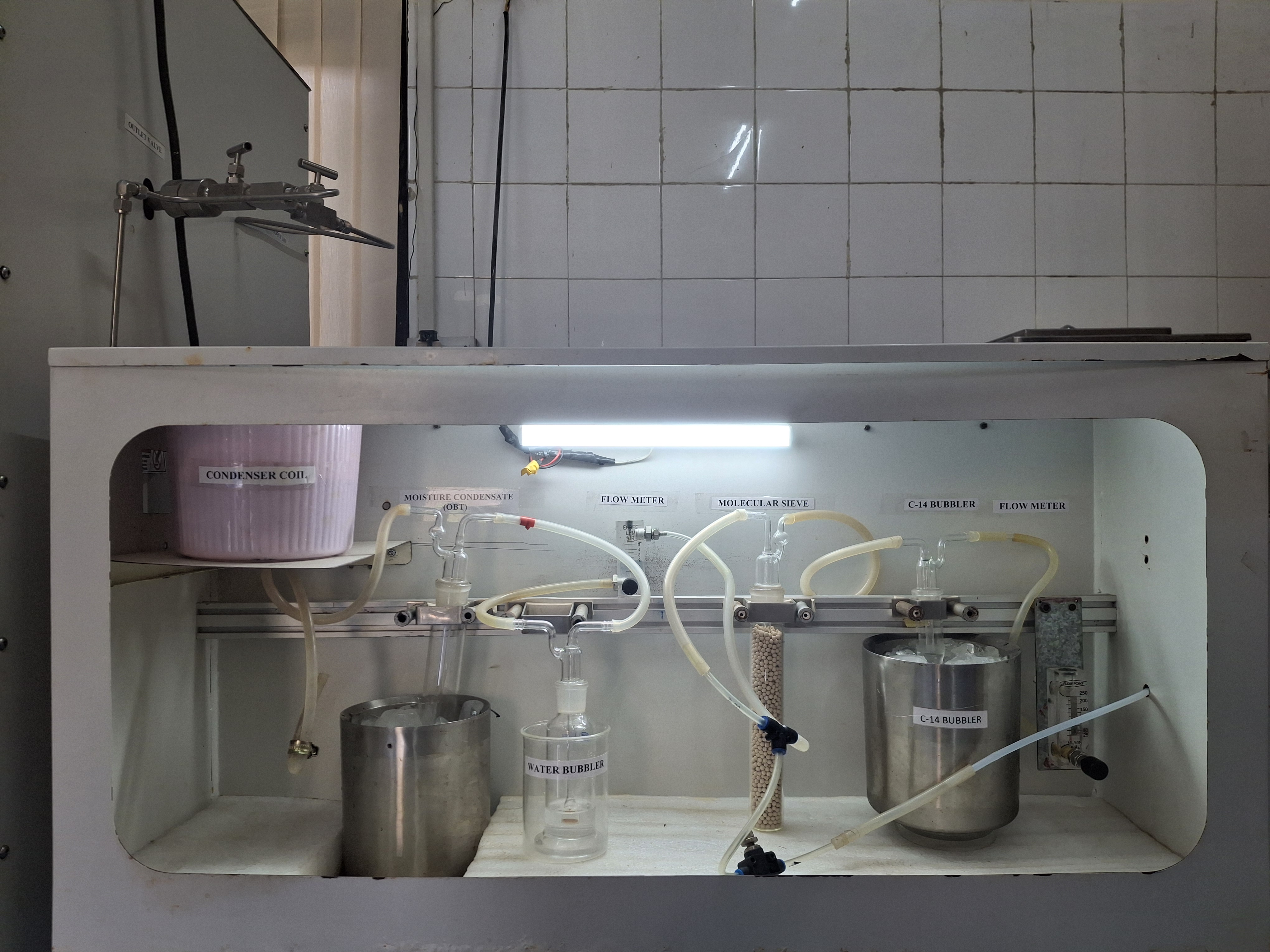
The tritium and carbon-14 (C-14) incorporated into organic tissues of biota, i.e., Organically Bound Tritium (OBT) and C-14, need oxidation of dried samples for their extraction and further quantification. The dried biota samples are introduced to a combustion chamber filled with oxygen gas at a higher pressure and the metallic heater surrounding the combustion chamber provide adequate temperature to completely combust the sample. The combustion moisture containing OBT and CO2 containing 14C is collected at different sampling set-ups. These sample extracts were taken for liquid scintillation counting for the determination of organically bound tritium (OBT) and carbon-14
The dried biota samples taken in different racks are introduced to the combustion chamber using a gear driven system and the chamber is filled with Oxygen gas at pressure of 3.0 kg/cm2. A series of metallic heating systems produces adequate temperature depending on the type of sample (450-600°C); however, the system can be operated up to 800°C. A sample mass of 40-50g can be introduced to the system, and the combustion moisture containing OBT and CO2 containing 14C are collected at different sampling set-ups. These sample extracts were taken for Liquid Scintillation Counting for the determination of Organically Bound Tritium (OBT) and Carbon-14.
The newly developed system is highly useful to all the Environmental Survey Laboratories (ESLs) within Department of Atomic Energy (DAE) and also Universities working on OBT and C-14. The system can also be used for the determination of the Water Equivalent Factor of vegetation (WEQp} and marine organism (WEQf) samples. The usability of the system can be explored for the estimation of Tritium and Carbon-14 in cotton and organic wastes generated at nuclear facilities .
The Tritium and Carbon-14 are the two important low energy beta emitting radionuclides released by a Pressurized Heavy Water Reactor and Fuel Reprocessing Facilities into the environment and are incorporated by living biota into organic tissues and in turn deliver dose to the public on ingestion. The tritium and C-14 incorporated into organic tissues, i.e., Organically Bound Tritium (OBT) and C-14, are quantified after oxidation of dried samples. Laboratories engaged in routine monitoring of OBT and Carbon-14 currently use mainly two imported systems: the Sample Oxidation system and the Pyrolyser system, which can handle sample masses ranging from 0.5-1.0 g and 2-5 g, respectively, and also are highly expensive. To overcome these limitations, a cost effective semi-automatic sample oxidation system with higher sensitivity (which can handle large sample mass) is indigenously designed and developed for the combustion of the dried biota sample for the extraction of Carbon dioxide (CO2) containing Carbon-14 and combustion moisture containing OBT (Fig.1& Fig.2).
The system can be used for the combustion of a large mass of dried biota sample and hence can achieve a lower Minimum Detectable level of Activity (MDA) for OBT and C-14.
The newly developed system is highly useful to all the Environmental Survey Laboratories (ESLs) within DAE and also Universities working on OBT and C-14 for its measurement in different environmental biota.
The principle involved in the process is the complete combustion of the dried sample in the presence of an adequate amount of oxygen and the separation of OBT and C-14 in an appropriate sampling set-up.
RAW MATERIALSs
Oxygen gas is used as the medium of combustion of dried biota sample in presence of metallic heating system at a varying temperature of 450-600ºC for different types of samples. Nitrogen gas is used as a purge gas for carrying the moisture and CO2 to the respective trapping set up. For CO2 (14C) absorption, Permaflour E and Carbosorb S mixture is used as absorbent. Crushed ice is used for the steam condensation (OBT) and heated molecular sieve is used for the drying of the CO2 gas before being absorbed.
INFRASTRUCTURE
The infrastructure required for manufacturing of the system is the Fabrication Shop (CNC Laser Cutting, CNC Press Brake, Arc Welding), Powder Coating Machine, Curing Machine, Power Tools, Assembly Facility, Machine Tools (Lathe, Drilling, Grinder), Manpower such as Turner, Fitter, Welder and electrician etc. After manufacturing, for routine operation of the system, a 3-phase power supply is required for running the system, an air oven for drying the sample, a molecular sieve for moisture absorption, O2 and N2 gas cylinders as combustion gas and carrier gas respectively.
MANPOWER
The manpower requirements are 1 Graduate/Post graduate in science & 1 skilled laboratory technician for the routine operation of the system.