
Core R & D Areas
include
Development of stand-alone environmental radiation monitors and establishment of countrywide monitoring network with online data communication |
Development of radiation monitoring systems, software and impact assessment methodologies for strengthening nuclear and radiological emergency preparedness at the National level. |
Under the IERMON (Indian Environmental Radiation Monitoring Network) program, more than 100 environmental radiation monitoring systems across the country have been established |
Environmental safety surveillance, radiation protection and industrial hygiene surveillance in the nuclear fuel cycle to all the operating units |
Environmental monitoring and radiological impact assessment at different DAE sites |
Initiation of a program to monitor background level of gamma radiation at sites other than DAE sites across the country |
Synthesis and characterisation of LiMgPO4,Tb,B, OSL phosphor for personnel, medical and population dosimetry |
| Design of a prototype smart four-element Optically Stimulated Luminescence Dosimeter (OSLD) badge based on thin á -Al2O3:C discs |
Development and installation of Tritium monitors using indigenously developed detector assembly at various DAE facilities |
Development of Liquid scintillator based betagamma coincidence system, standard facility for beta dose measurement and automatic calibration systems for quality assurance in personnel monitoring |
Establishment of an advanced biodosimetric laboratory for the assessment of accident and overexposures |
Indigenously-developed on-line monitors for measurement of radon and thoron |
Development of deposition-based radon / thoron progeny sensors |
Maintaining a National Occupational Dose Registry System with a linked network between all DAE units |
Design & development of National Emergency Response System. |
|
|
In recent years, environmental issues are playing an increasing role in the consideration of options available for energy production. In the context of nuclear power, environmental protection and public safety are inextricably linked to the setting up, operation and decommissioning of the entire fuel cycle facilities. Broadly speaking, these pertain to the protection of occupational workers, general public and the environment at large. In the occupational domain, radiation exposures to workers need to be controlled, so as to meet the rigorous standards stipulated by regulatory agencies. This is achieved both at the level of design and at the level of operation by comprehensive research, development and application studies on: Environmental impact and dose / risk assessment for radiological and chemical contaminants; Environmental surveillance and radiological protection for the front-end of the nuclear fuel cycle; Meteorological and hydro-geological investigations for DAE sites; Modelling of contaminant transport and dispersion in the atmosphere and hydrosphere; Radiological impact assessment of waste management and disposal practices; Establishment of benchmarks for assessing the radiological impact of the nuclear power activities on the marine environment in the Asia Pacific Region and related radioecology studies and through Receptor modeling for source apportionment. Additionally, the radiological safety evaluation of various upcoming particle accelerators and Accelerator Driven Systems (ADS) is also being carried out.
Several programmes have been initiated towards individual and environment monitoring and radiation safety and dosimetry in medical applications of radiation. Personnel monitoring services to all DAE units
and support to the regulatory authorities in assessment of genuineness of dose for overexposure
situations is also provided. Several training and certification courses in radiological physics and safety are being conducted on a regular basis.
|
Click the image for bigger view
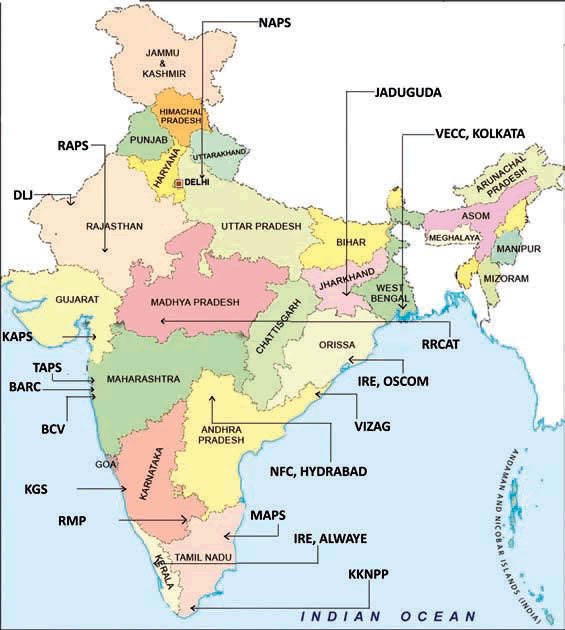
Environmental gamma radiation monitoring sites around DAE installations
Click the image for bigger view
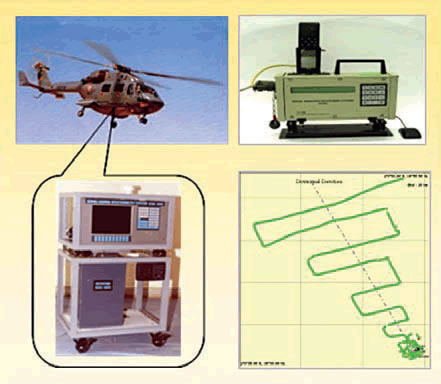
Systems and methodology developed for Aerial Radiation Monitoring [Aerial Gamma Spectrometry System (AGSS) and Compact Aerial Radiation Monitoring System (CARMS)]
|